Skip to content
Territorial Integrity · History

Tigri: A Story of Right vs. Might.

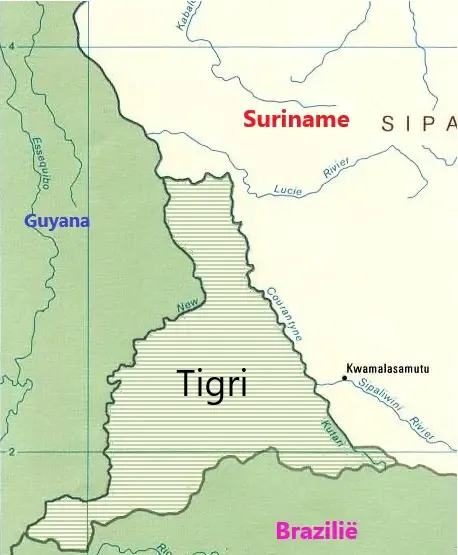
Suriname’s state position includes Tigri within the Republic of Suriname. Guyana has exercised military control there since taking Camp Tigri in 1969. This timeline examines the historical basis of Suriname’s claim and distinguishes legal title from effective control.

Map of the Tigri Area

The Tigri Issue: A Legal Timeline

Historical events, sources and their significance for Suriname’s territorial claim.

1799

The Amical Arrangement

The colonial governors of Suriname and Berbice agreed to use the Corentyne River as their boundary in 1799, with river islands remaining under Suriname's administration. The agreement later became an important reference in disputes over the river and its headwaters.
Significance:A major early documentary basis for Suriname's claim concerning the Corentyne River. The 1799 agreement informs, but does not by itself settle, the later Tigri headwaters dispute.
1814

Convention of London (1814)

Under the 1814 Convention of London, Suriname was to return to Dutch rule, while Demerara, Essequibo and Berbice were ceded to Britain. The treaty did not define the disputed inland headwaters of the Corentyne River.
Significance:The agreement reshaped colonial sovereignty, but the reference to possessions held in 1803 did not, by itself, definitively settle the later Tigri border dispute.
1840–1843

Schomburgk’s surveys

Schomburgk’s surveys mapped the upper Corentyne. His identification of the Kutari/Coeroeni later became an important part of the British boundary position.
Significance:A survey is not a boundary treaty. The significance of its maps also depends on subsequent agreements and state conduct.
1871

The New River and Suriname’s historical title

Brown’s 1871 survey supports the geographical basis of Suriname’s claim to Tigri. Establishing legal title also requires boundary agreements and evidence of subsequent state conduct.
Significance:Brown’s geographical evidence supports Suriname’s interpretation of the boundary river; it does not automatically establish sovereignty.
1900

Dutch objections and British rejection

The Netherlands challenged the identification of the Kutari/Coeroeni as the continuation of the Corentyne. Britain maintained its boundary position.
Significance:The correspondence matters to whether the governments accepted or challenged the boundary; the original diplomatic notes require separate analysis.
1936–1939

Boundary commission and draft treaty

The boundary commission established a tripoint at the Kutari and a northern boundary point near the river mouth. A British draft treaty followed in 1939.
Significance:The 2007 maritime award records that the Netherlands did not answer the draft before the war. The legal scope of the separate commission documents requires its own examination.
1965

Renaming as Upper Corentyne

Suriname officially adopted the name Upper Corentyne for the New River, expressing its position on the continuation of the boundary river.
Significance:An official name expresses a state’s position but does not by itself change an international boundary.
1968

DEFPOL and the presence in Tigri

Suriname expanded its defence police and presence in the southwest. Camp Tigri became an important post in the border region.
Significance:The presence is relevant to the history of administration; it does not replace investigation of the existing legal title.
19 August 1969

Attack on Camp Tigri

Guyanese troops took Camp Tigri on 19 August 1969 and displaced its Surinamese personnel. Suriname maintained its territorial claim.
Significance:Military control and legal sovereignty are different questions. There is no universal fifty-year prescription period automatically deciding territorial title.
1970

Talks at Chaguaramas

Following the events of 1969, the governments of Suriname and Guyana held talks in Trinidad and Tobago in 1970 on reducing tensions.
Significance:Suriname invokes arrangements concerning military presence in later protests. These talks are distinct from the 1973 CARICOM Treaty of Chaguaramas and do not by themselves establish recognition of sovereignty.
25 November 1975

Independence and the inherited boundary question

Suriname became independent on 25 November 1975. A historical publication reproduces Den Uyl’s boundary description to Prime Minister Arron, including the Upper Corentyne in the western boundary.
Significance:This description supports continuity of Suriname’s boundary position at independence. A Dutch-Surinamese confirmation does not automatically bind Guyana; the original letter and prior title remain important.
17 September 2007

Arbitral award on the maritime boundary

An arbitral tribunal under Annex VII of the UN Convention on the Law of the Sea delimited the maritime boundary between Suriname and Guyana. The PCA provided administrative support.
Significance:The award concerned the territorial sea, exclusive economic zone and continental shelf; it did not decide land sovereignty in Tigri.
November 2024

Protest over infrastructure at Camp Tigri

Suriname lodged a diplomatic protest in November 2024 over Guyanese plans for the airstrip at Camp Tigri, called Camp Jaguar by Guyana.
Significance:According to contemporary reporting, Suriname invoked earlier arrangements on military presence. The protest records Suriname’s objection; it is not a judicial determination of title.

Our Stance:

"We show Tigri as part of Suriname, consistent with Suriname’s position on territorial integrity. Historical and legal arguments are explained with sources; foreign administration or military presence does not by itself establish legal title."

Consulted Sources & Documentation

1799 Treaty (Amical Arrangement)

The fundamental agreement between the governors of Suriname and Berbice, analyzed in the PCA Arbitral Award (2007).

1936 boundary commission and 1939 draft treaty

The 2007 arbitral award describes the commission and subsequent draft. This is not a link to a ratified Tigri boundary treaty.

Dr. J.H. Adhin (1968)

Bibliographic reference to a historical legal analysis; the catalogue entry is not a judicial determination.

Reporting on Suriname’s protest (2024)

News report about the diplomatic protest. The complete original protest note is not reproduced here.