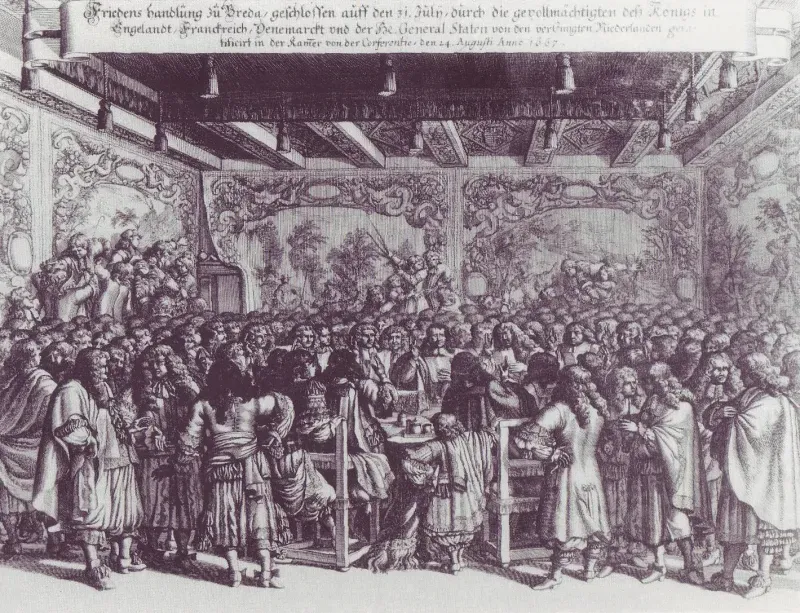
The peace settlement
The Treaty of Breda ended the Second Anglo-Dutch War. The parties generally retained territories held at the agreed point during the negotiations: England kept New Netherland and New Amsterdam, while the Dutch Republic retained Suriname and the island of Run. It was not a simple two-territory swap.
"The Dutch raid on the Medway weakened England's negotiating position and helped advance the peace talks in Breda."
Timeline of the Treaty of Breda
From the fall of New Amsterdam to the final peace.
1664
The surrender of New Amsterdam
In 1664 New Amsterdam passed into English control after negotiations and was renamed New York. The takeover of New Netherland preceded the formal war of 1665.
Significance:The takeover formed part of wider colonial and commercial tensions; it was not the war’s sole cause.
1665
Second Anglo-Dutch War
The formal Second Anglo-Dutch War began in 1665 after earlier confrontations at sea and in the colonies.
Significance:Commercial interests, colonial expansion and political rivalry interacted. Peace was concluded at Breda in 1667.
13 June 1665
Battle of Lowestoft
The English fleet defeated the Dutch at Lowestoft. The flagship Eendracht exploded, killing Admiral Jacob van Wassenaer Obdam.
Significance:This was the war’s first major fleet battle. The date uses the Gregorian calendar; English sources also give 3 June in the Julian calendar then in use.
11–14 June 1666
Four Days’ Battle
The Dutch fleet under Michiel de Ruyter won a four-day battle against the English fleet.
Significance:The battle did not decide the war: another English victory followed later in 1666. These dates are Gregorian; English sources also use 1–4 June.
August 1666
Two Days’ Battle and Holmes’s Bonfire
After an English victory in the Two Days’ Battle, a force under Robert Holmes destroyed merchant shipping in the Vlie and burned much of West-Terschelling.
Significance:The naval battle and subsequent raid were separate events. The raid on 19–20 August Gregorian is also dated 9–10 August Julian in English sources.
February 1667
Crijnssen captures Fort Willoughby
The Zeeland expedition under Abraham Crijnssen captured Fort Willoughby in Suriname. It was renamed Fort Zeelandia.
Significance:The capture preceded the peace of Breda. The colonial transfer affected a plantation society in which slavery played a central role.
May 1667
Peace negotiations at Breda
Diplomats met at Breda in May 1667 to negotiate peace while the war continued.
Significance:The negotiations concerned several commercial and colonial issues. The Medway raid took place during this diplomatic process.
June 1667
The Raid on the Medway
Dutch forces attacked English warships in the Medway and carried the Royal Charles back to the Netherlands.
Significance:The raid increased pressure on England during the ongoing peace negotiations. It did not destroy the entire English fleet.
31 July 1667
Signing of the Peace of Breda
The peace of Breda ended the war on 31 July 1667. The Dutch Republic retained Suriname; England retained New Netherland.
Significance:This was a wider colonial and commercial settlement, not a simple direct exchange of Suriname for Manhattan. It did not fully delimit Suriname’s inland boundaries.
24 August 1667
Ratification and proclamation of peace
The peace of Breda was ratified and proclaimed on 24 August 1667. The Rijksmuseum holds an original Dutch publication of the ratification.
Significance:This confirmed the peace settlement; it did not fix every colonial boundary for the centuries that followed.
Our Stance:
"The treaty was a major legal and historical milestone in confirming Dutch colonial control over Suriname, not the founding of Suriname as a country."
Consulted Sources
Treaty of Breda (1667) - National Archives
Original treaty from the States-General archives (inventory 1.01.02, nr. 12588.7).
Cornelis Ch. Goslinga (UFDC)
"The Dutch in the Caribbean and on the Wild Coast 1580-1680" - Essential scholarly work on the region.
C.R. Boxer (Internet Archive)
"The Dutch Seaborne Empire 1600-1800" - Academic analysis of the Dutch colonial empire.
Historisch Nieuwsblad
Suriname Dossier: Articles on economic value and diplomatic settlement.